Wagner
Welten
Explore
Opera archive
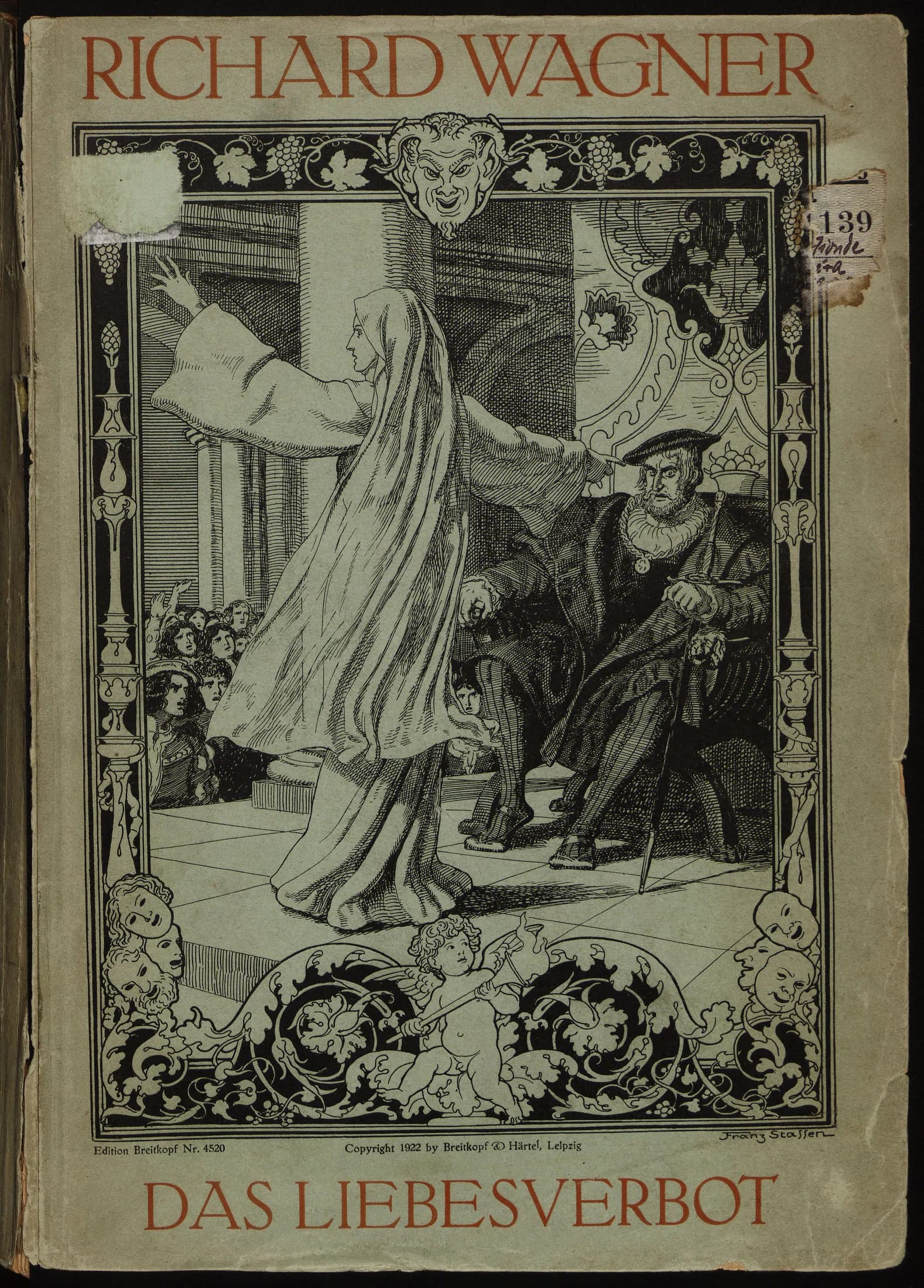
Illustrated cover for Das Liebesverbot

Opera world 02 / WWV 38

DasLiebesverbot

Prohibition enters through the palace. Desire returns through the streets.

A city orders desire to disappear
Scroll to enter

01 / The dramatic threshold

A city orders desire
to disappear

In Wagner's second completed opera, Palermo becomes a pressure chamber. Friedrich closes the carnival, bans pleasure and condemns others for desires he cannot govern in himself.

The music refuses the austerity of the decree. Rhythms push outward, doors open, disguises multiply and the city finally answers power with a festival it was ordered not to have.

02 / Liebesverbot

Franz Stassen edition cover, 1922

02 / The action

The world changes
in movements.

This is a dramatic map, not a replacement for the full libretto. Each movement marks a change in what the characters believe is possible.
  1. I

    The decree

    Pleasure becomes a crime

    Palermo under a new governor

    Friedrich imposes a severe moral code and condemns Claudio. Isabella enters to ask for mercy, only to discover that the governor's public purity hides private desire.

    Dramatic turnThe law reveals itself as appetite wearing a uniform.
  2. II

    The counterplot

    A mask tells the truth

    The convent, the palace, the forbidden carnival

    Isabella and Mariana arrange an exchange. While Friedrich believes he is meeting Isabella, the woman he abandoned takes her place, and the city prepares to break the ban in public.

    Dramatic turnDisguise makes hypocrisy visible.
  3. Finale

    The street

    The city takes back its body

    Carnival square

    The returning viceroy interrupts the collapse of Friedrich's authority. Punishment gives way to exposure, reconciliation and a finale driven by collective movement.

    Dramatic turnThe decree disappears beneath music, dance and public laughter.
Illustrated cover for Das Liebesverbot
Archive fragment

Franz Stassen edition cover, 1922

Image source ↗

03 / The dramatic machine

What moves
beneath the plot.

Objects, musical ideas and theatrical systems carry memory across the work. These are three ways into its deeper construction.

Austere on paper

Law

The prohibition is designed as absolute language: cold, vertical and public. Its weakness is that the ruler is not outside the desire he condemns.
Identity becomes mobile

Disguise

Masks and substitutions do not conceal the truth. They create the conditions under which it can finally be seen.

The many answer the one

Carnival

The crowd is not background. Collective rhythm becomes a political force, dissolving the distance between stage and street.

04 / Figures in the world

Six lines of
dramatic pressure.

Each figure occupies a different distance from the work's central conflict. Voice type is included as a practical listening guide.
01

Isabella

Soprano

A novice who turns moral language against power
02

Friedrich

Baritone

The governor whose law exposes his hypocrisy
03

Luzio

Tenor

A friend of Claudio and agent of comic disorder
04

Mariana

Soprano

Friedrich's abandoned wife and partner in the counterplot
05

Claudio

Tenor

A young man condemned under the new code
06

Dorella

Soprano

A lively presence in Palermo's resistance

05 / A line from the stage

So sei's! Palermo sei heut frei!
So be it. Palermo shall be free today.

Freedom arrives not as a private escape, but as a city changing tempo together.

Finale

06 / The work in time

A stage world
with a physical history.

Dates and categories anchor the experience without reducing the opera to a catalogue entry. The archive remains visible behind the theatre.
Literary source
Shakespeare, Measure for Measure
Setting
Palermo, imagined as a city of carnival
First performance
Magdeburg, 29 March 1836
Dramatic shape
Two acts and a public reversal
WWV 38

Comic opera in two acts

07 / The living work

Find the next
Liebesverbot.

The performance world will connect this opera to verified dates, theatres and productions across Europe. The architecture is ready for listings that can be traced directly to presenting institutions.

Open performances