Wagner
Welten
Explore
Opera archive
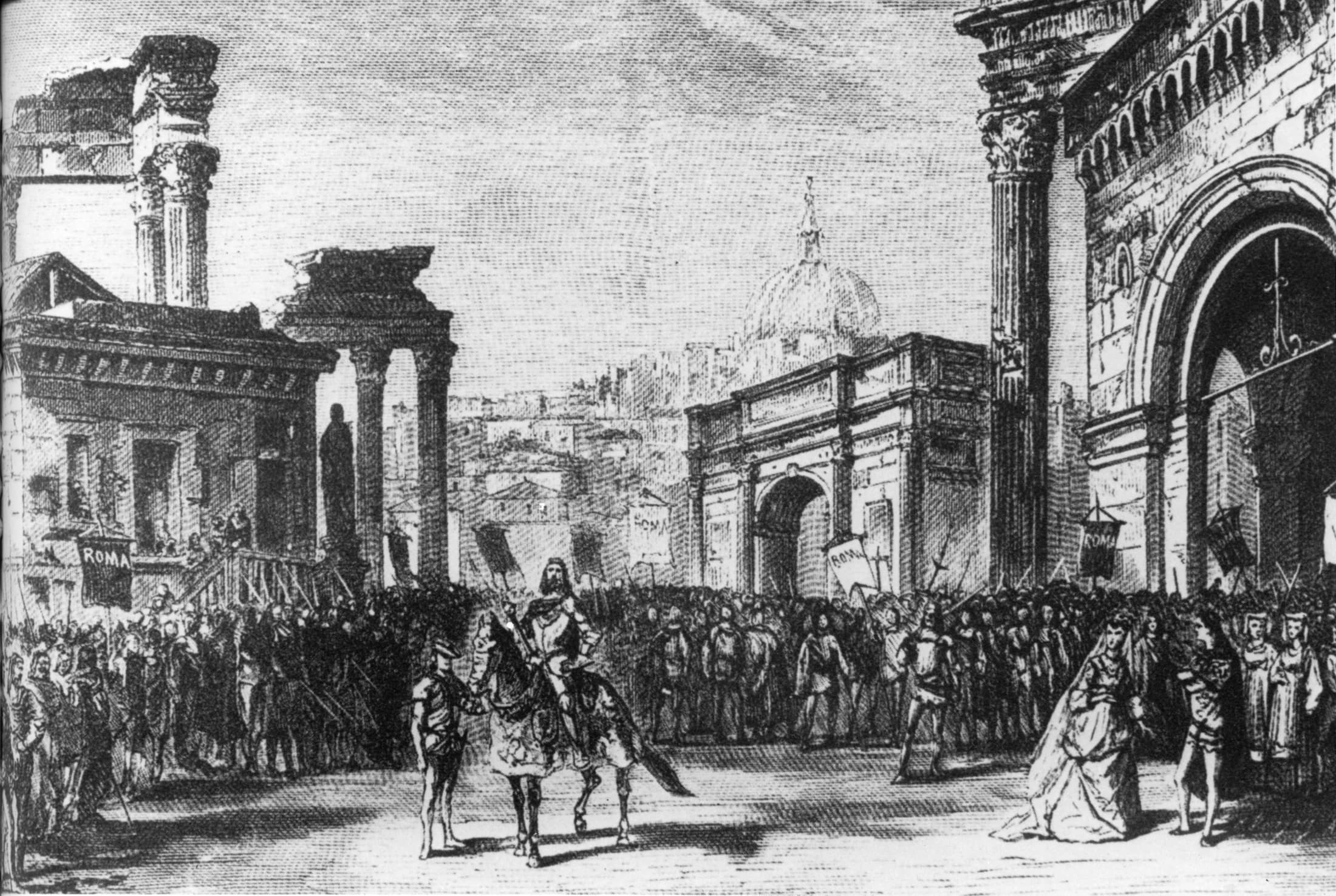
Nineteenth-century illustration of a production of Rienzi

Opera world 03 / WWV 49

Rienzi

First the voice gathers the city. Then the city turns around.

A crowd builds the monument it will destroy
Scroll to enter

01 / The dramatic threshold

A crowd builds the
monument it will destroy

Rienzi begins with political theatre and ends in fire. A tribune promises Rome renewal, masters the scale of public spectacle, and discovers that adoration is only another unstable form of power.

Here Wagner works on a vast surface: processions, bells, prayers, battle calls and massed voices. The individual can rise above the crowd only for as long as the crowd continues to look upward.

03 / Rienzi

Paris production illustration, 1869

02 / The action

The world changes
in movements.

This is a dramatic map, not a replacement for the full libretto. Each movement marks a change in what the characters believe is possible.
  1. I–II

    The ascent

    Rome invents its tribune

    A street, then the Capitol

    Rienzi stops a conflict between noble factions and calls the people toward civic order. Acclamation transforms a private man into a public image.

    Dramatic turnAuthority is born in the instant thousands repeat one name.
  2. III–IV

    The fracture

    Mercy becomes weakness

    The battlefield and the Lateran

    Rienzi defeats the nobles but spares them. Conspiracy returns, Adrian turns against him, and the church withdraws protection while bells recast triumph as isolation.

    Dramatic turnThe sound that once crowned him now empties the space around him.
  3. V

    The fall

    The monument burns from below

    The Capitol

    Rienzi prays, tries once more to address the people, and is answered by stones and flame. Irene remains with him as the building collapses.

    Dramatic turnThe crowd destroys the image through which it once imagined itself.
Nineteenth-century illustration of a production of Rienzi
Archive fragment

Paris production illustration, 1869

Image source ↗

03 / The dramatic machine

What moves
beneath the plot.

Objects, musical ideas and theatrical systems carry memory across the work. These are three ways into its deeper construction.

A name becomes architecture

Acclamation

Rienzi's power is acoustic before it is legal. Public repetition constructs the leader in real time.
Signal / sentence

The bell

Ceremonial sound changes meaning across the work, moving from civic order toward spiritual abandonment.

History consumes its image

Fire

The last spectacle is not controlled by Rienzi. The stage machine that created grandeur becomes the mechanism of collapse.

04 / Figures in the world

Six lines of
dramatic pressure.

Each figure occupies a different distance from the work's central conflict. Voice type is included as a practical listening guide.
01

Cola Rienzi

Tenor

Tribune of Rome, made and unmade in public
02

Irene

Soprano

Rienzi's sister, loyal through the final collapse
03

Adriano

Mezzo-soprano

A Colonna torn between love and inheritance
04

Steffano Colonna

Bass

Head of a noble faction
05

Paolo Orsini

Bass

Colonna's rival and partner in revolt
06

The People of Rome

Chorus

The work's decisive political body

05 / A line from the stage

Allmächt'ger Vater, blick herab!
Almighty Father, look down upon me.

At the end, the public orator has only a private prayer.

Rienzi, Act V

06 / The work in time

A stage world
with a physical history.

Dates and categories anchor the experience without reducing the opera to a catalogue entry. The archive remains visible behind the theatre.
Literary source
Edward Bulwer-Lytton, Rienzi
Setting
Rome in the fourteenth century
First performance
Dresden, 20 October 1842
Dramatic shape
Five acts on the scale of grand opera
WWV 49

Grand tragic opera in five acts

07 / The living work

Find the next
Rienzi.

The performance world will connect this opera to verified dates, theatres and productions across Europe. The architecture is ready for listings that can be traced directly to presenting institutions.

Open performances