Wagner
Welten
Explore
Opera archive
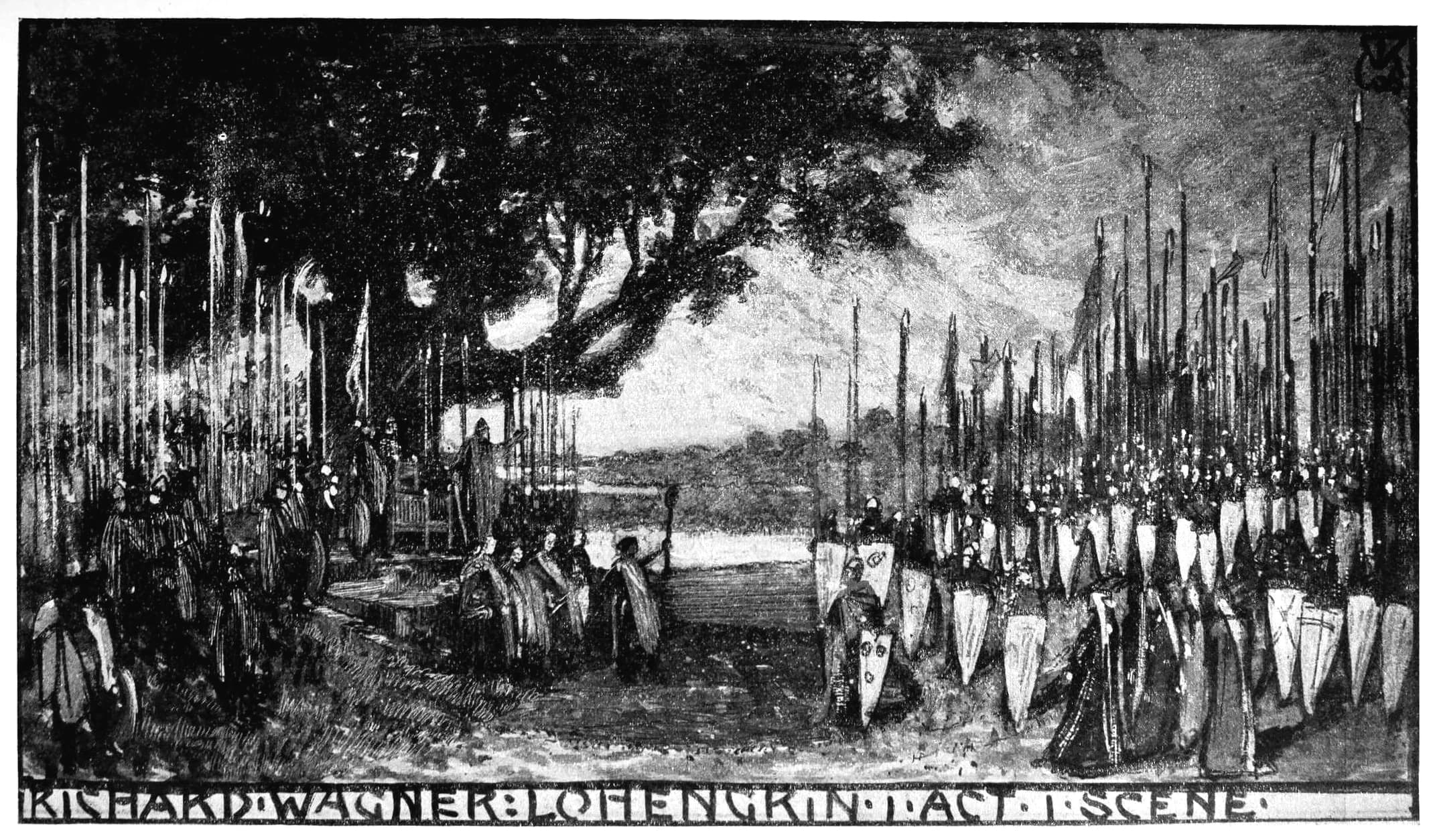
Alfred Roller stage design for Act I of Lohengrin

Opera world 06 / WWV 75

Lohengrin

A stranger arrives with one condition: do not ask his name.

Trust is demanded without knowledge
Scroll to enter

01 / The dramatic threshold

Trust is demanded without
knowledge

Elsa's defender comes across the water as an answer to a vision. His identity can remain sacred only while unspoken, yet the marriage he offers requires a trust no ordinary human relationship can sustain.

The opera appears luminous, ceremonial and still. Beneath that surface, questions move like pressure through glass until one sentence breaks the entire world.

06 / Lohengrin

Alfred Roller, Act I design, 1905

02 / The action

The world changes
in movements.

This is a dramatic map, not a replacement for the full libretto. Each movement marks a change in what the characters believe is possible.
  1. I

    The arrival

    A vision takes physical form

    The banks of the Scheldt near Antwerp

    Elsa is accused of murdering her brother. She names a knight seen in a dream, and a swan draws him into the public assembly to fight for her innocence.

    Dramatic turnThe miracle offers rescue and a prohibition at the same time.
  2. II

    The infection

    Doubt enters through the edge of the ceremony

    The fortress at night

    Ortrud and Telramund exploit the silence around Lohengrin's identity. As wedding ritual gathers force, suspicion gives Elsa a question she can no longer keep outside herself.

    Dramatic turnThe unknown changes from shelter into threat.
  3. III

    The name

    Knowledge ends the miracle

    The bridal chamber and the banks of the Scheldt

    Elsa asks. Lohengrin reveals his origin as a knight of the Grail, but revelation requires departure. The swan's final transformation returns the lost heir too late to save the marriage.

    Dramatic turnThe answer is true, complete and fatal to the world that needed it.
Alfred Roller stage design for Act I of Lohengrin
Archive fragment

Alfred Roller, Act I design, 1905

Image source ↗

03 / The dramatic machine

What moves
beneath the plot.

Objects, musical ideas and theatrical systems carry memory across the work. These are three ways into its deeper construction.

Name / origin

The question

The forbidden question is not merely curiosity. It tests whether intimacy can exist when one person controls the terms of knowledge.
Arrival without explanation

The swan

The image is graceful and impossible. It places supernatural movement inside a political landscape.

Public order, private fracture

Ceremony

Processions and choral blocks build a social architecture that the private question quietly destabilizes.

04 / Figures in the world

Six lines of
dramatic pressure.

Each figure occupies a different distance from the work's central conflict. Voice type is included as a practical listening guide.
01

Lohengrin

Tenor

A knight of the Grail who arrives under a prohibition
02

Elsa

Soprano

A woman rescued by the figure of her own vision
03

Ortrud

Mezzo-soprano

A strategist who turns uncertainty into power
04

Telramund

Baritone

A nobleman whose accusation becomes obsession
05

King Heinrich

Bass

The ruler seeking unity in Brabant
06

The Herald

Baritone

The voice that converts action into public order

05 / A line from the stage

Nie sollst du mich befragen.
Never shall you question me.

The condition arrives inside the declaration of love.

Lohengrin, Act I

06 / The work in time

A stage world
with a physical history.

Dates and categories anchor the experience without reducing the opera to a catalogue entry. The archive remains visible behind the theatre.
Legendary source
The medieval Lohengrin and Grail traditions
Setting
Antwerp, first half of the tenth century
First performance
Weimar, 28 August 1850
Conductor at premiere
Franz Liszt
WWV 75

Romantic opera in three acts

07 / The living work

Find the next
Lohengrin.

The performance world will connect this opera to verified dates, theatres and productions across Europe. The architecture is ready for listings that can be traced directly to presenting institutions.

Open performances