Wagner
Welten
Explore
Opera archive
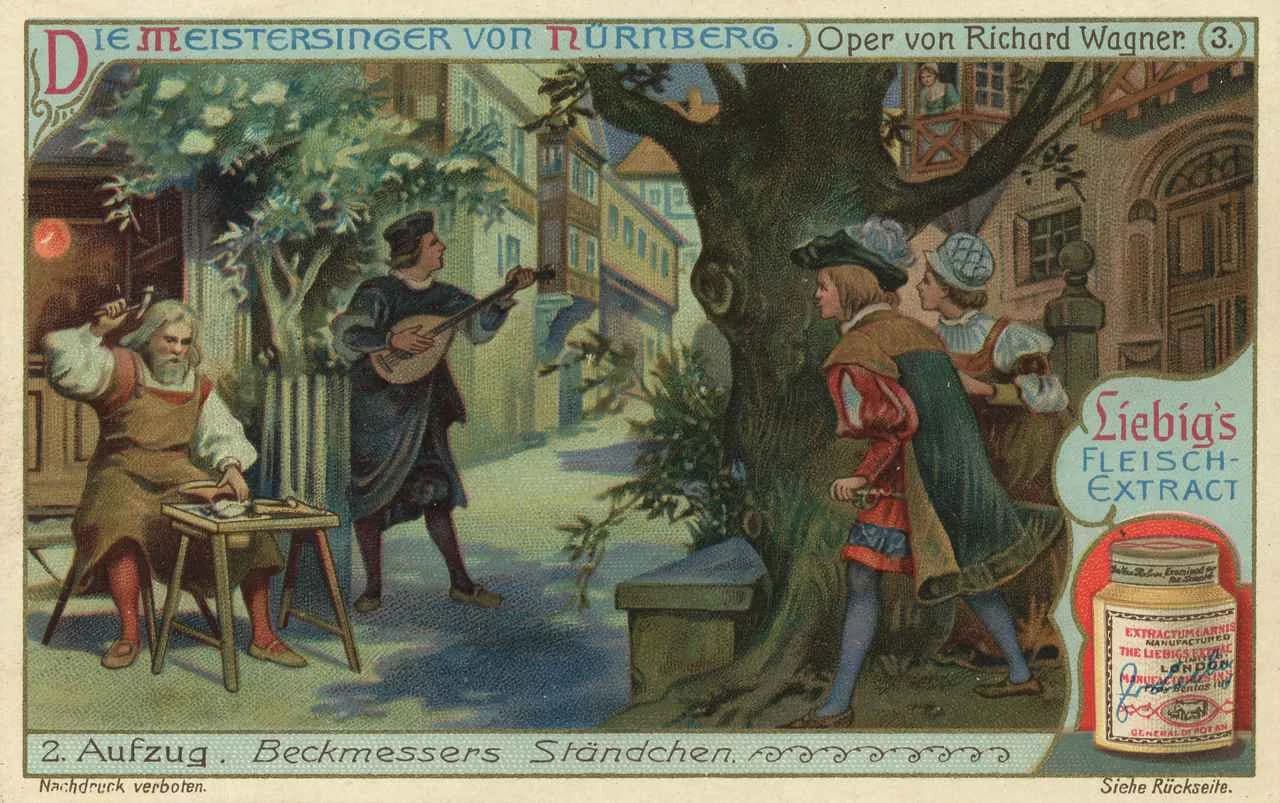
Historical illustration of Beckmesser's serenade in Die Meistersinger

Opera world 10 / WWV 96

Die Meistersingervon Nürnberg

A new song enters a city whose rules know every old one.

Tradition survives by permitting transformation
Scroll to enter

01 / The dramatic threshold

Tradition survives by permitting
transformation

Walther wants to win Eva and must learn the craft of the mastersingers. Hans Sachs recognizes that living tradition needs rules, memory and the courage to hear what those rules do not yet describe.

The comedy is built like a city: lanes of counterpoint, workshops, windows, public ritual and private listening. Order repeatedly tips into noise, then reorganizes at a larger scale.

10 / Die Meistersinger

Beckmesser's serenade, illustration published 1912

02 / The action

The world changes
in movements.

This is a dramatic map, not a replacement for the full libretto. Each movement marks a change in what the characters believe is possible.
  1. I

    The trial song

    A rulebook meets a voice it cannot measure

    St Catherine's Church

    Walther learns that Eva's hand will be awarded through a song contest. His spontaneous trial song violates the masters' tabulature and is marked into failure by Beckmesser.

    Dramatic turnThe song fails the test while awakening the one listener able to understand it.
  2. II

    The street

    A serenade becomes a riot

    A Nuremberg lane at night

    Sachs interrupts Beckmesser's serenade with hammer blows. David misreads the scene, neighbours pour into the street, and the carefully ordered city erupts into comic polyphony.

    Dramatic turnSocial order is revealed as music that can lose its beat.
  3. III

    The meadow

    The new song enters tradition

    Sachs's workshop and the festival meadow

    Sachs helps Walther shape the dream song without emptying its originality. At the contest, the community hears what the rules could not predict.

    Dramatic turnTradition continues because it changes its criteria after listening.
Historical illustration of Beckmesser's serenade in Die Meistersinger
Archive fragment

Beckmesser's serenade, illustration published 1912

Image source ↗

03 / The dramatic machine

What moves
beneath the plot.

Objects, musical ideas and theatrical systems carry memory across the work. These are three ways into its deeper construction.

Error made visible

The marker's slate

Every deviation is recorded. The comic object reveals the danger of a system that counts faults more easily than it hears form.
Work becomes counterpoint

The hammer

Sachs's cobbling rhythm comments on Beckmesser's song and turns craft into active musical criticism.

Invention shaped, not domesticated

The dream song

The new work is revised through dialogue. Its freedom is not the absence of craft, but craft made responsive to imagination.

04 / Figures in the world

Six lines of
dramatic pressure.

Each figure occupies a different distance from the work's central conflict. Voice type is included as a practical listening guide.
01

Hans Sachs

Bass-baritone

A shoemaker, poet and listener capable of change
02

Walther von Stolzing

Tenor

A knight whose song exceeds the inherited rules
03

Eva

Soprano

Pogner's daughter and an active judge of the competing worlds
04

Sixtus Beckmesser

Baritone

The town clerk and rigid guardian of error
05

Veit Pogner

Bass

A goldsmith who makes Eva the prize of the contest
06

David and Magdalene

Tenor and mezzo-soprano

A younger pair whose comedy mirrors the central courtship

05 / A line from the stage

Wahn! Wahn! Überall Wahn!
Madness, madness, everywhere madness.

The comedy pauses long enough to recognize the violence inside collective certainty.

Hans Sachs, Act III

06 / The work in time

A stage world
with a physical history.

Dates and categories anchor the experience without reducing the opera to a catalogue entry. The archive remains visible behind the theatre.
Setting
Nuremberg around the middle of the sixteenth century
Historical figure
Hans Sachs, poet and shoemaker
First performance
Munich, 21 June 1868
Dramatic shape
Three acts moving from church to street to meadow
WWV 96

Opera in three acts

07 / The living work

Find the next
Die Meistersinger.

The performance world will connect this opera to verified dates, theatres and productions across Europe. The architecture is ready for listings that can be traced directly to presenting institutions.

Open performances