Wagner
Welten
Explore
Opera archive
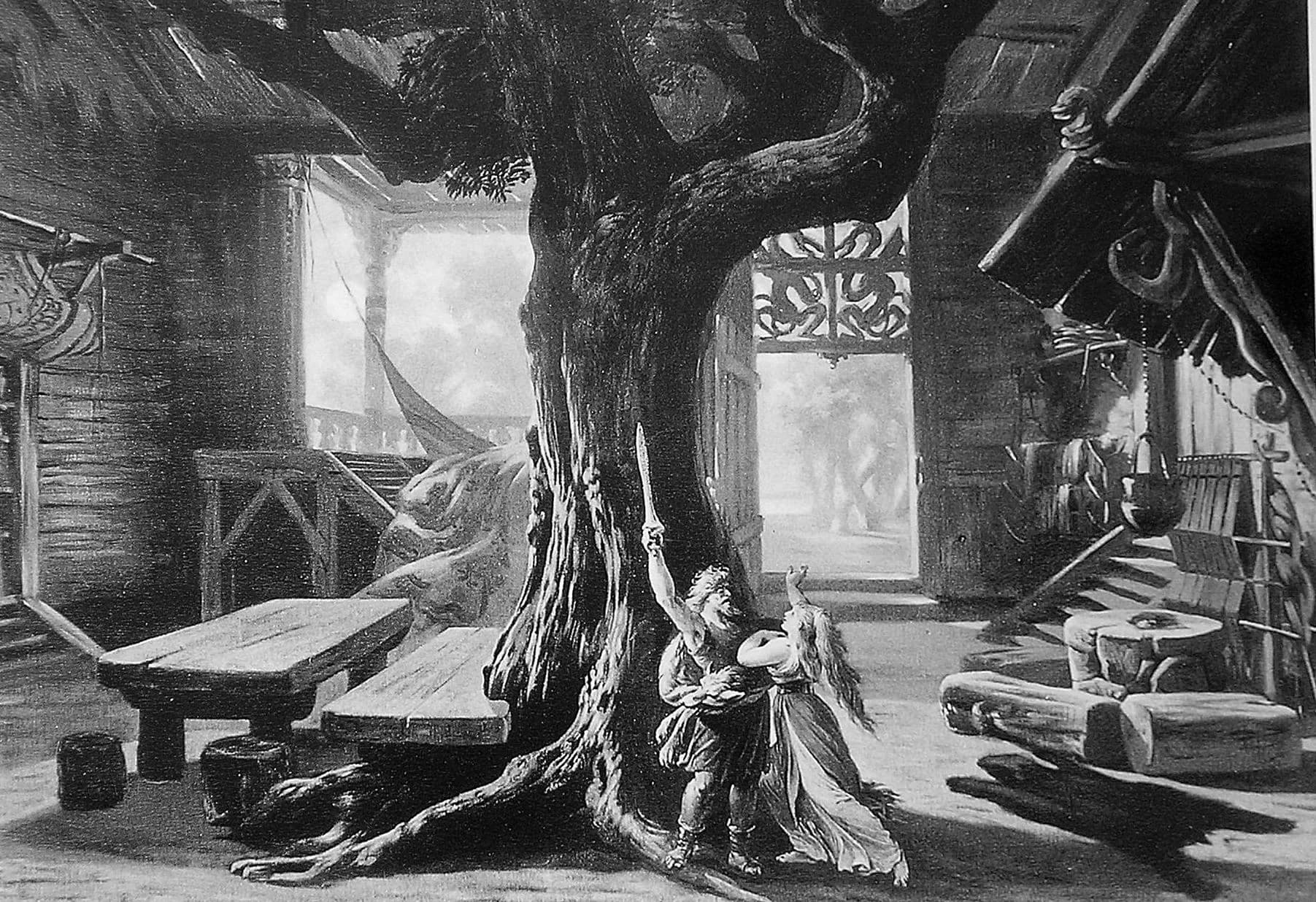
Josef Hoffmann design for Hunding's hut in Die Walküre

Opera world 08 / WWV 86B

DieWalküre

A storm drives a stranger toward the tree that remembers him.

Love speaks against the law of the gods
Scroll to enter

01 / The dramatic threshold

Love speaks against the
law of the gods

Die Walküre begins with human bodies in danger and expands into a crisis of divine law. Siegmund and Sieglinde recognize one another, while Brünnhilde learns that obedience can become betrayal of what is true.

The opera keeps moving the center of authority. First Wotan commands the world, then Fricka exposes his contradiction, then Brünnhilde hears the unspoken wish beneath his order.

08 / Walküre

Josef Hoffmann, Hunding's hut, 1876

02 / The action

The world changes
in movements.

This is a dramatic map, not a replacement for the full libretto. Each movement marks a change in what the characters believe is possible.
  1. I

    The house

    Two strangers remember the same origin

    Hunding's hut around an ash tree

    Siegmund seeks shelter, meets Sieglinde and draws the sword left for him in the tree. Recognition becomes love, and the house that confined her opens into night.

    Dramatic turnThe sword is found only when the forbidden relationship is named.
  2. II

    The command

    The god discovers that his freedom was already compromised

    A wild mountain pass

    Wotan orders Brünnhilde to protect Siegmund, then reverses the command under Fricka's argument. Brünnhilde meets Siegmund and changes side after witnessing his love.

    Dramatic turnCompassion becomes a higher form of hearing than obedience.
  3. III

    The fire

    Punishment becomes protection

    The Valkyries' rock

    The Valkyries gather the dead. Wotan confronts Brünnhilde, strips her divinity, then surrounds her sleep with fire so that only a fearless hero can cross.

    Dramatic turnThe father's sentence is transformed by the love he cannot admit as law.
Josef Hoffmann design for Hunding's hut in Die Walküre
Archive fragment

Josef Hoffmann, Hunding's hut, 1876

Image source ↗

03 / The dramatic machine

What moves
beneath the plot.

Objects, musical ideas and theatrical systems carry memory across the work. These are three ways into its deeper construction.

Memory inside architecture

The tree

The ash is both support and witness. The sword waits inside the domestic prison until identity can be recovered.
What is said / what is wanted

The order

Wotan's commands contradict his desire. Brünnhilde's tragedy begins when she understands him more deeply than literal obedience permits.

Barrier and promise

The fire

The ring of flame separates Brünnhilde from the gods, but also preserves the possibility of a future outside their order.

04 / Figures in the world

Six lines of
dramatic pressure.

Each figure occupies a different distance from the work's central conflict. Voice type is included as a practical listening guide.
01

Brünnhilde

Soprano

A Valkyrie who learns to act from compassion
02

Wotan

Bass-baritone

A god trapped inside laws he created
03

Siegmund

Tenor

A hunted Wälsung who finds love and identity together
04

Sieglinde

Soprano

A woman who escapes coercion and carries the future
05

Fricka

Mezzo-soprano

The advocate whose logic defeats Wotan's exception
06

Hunding

Bass

The violent host whose house is built on possession

05 / A line from the stage

Winterstürme wichen dem Wonnemond.
Winter storms have yielded to the moon of May.

The change of season is also the sudden discovery of a shared world.

Siegmund, Act I

06 / The work in time

A stage world
with a physical history.

Dates and categories anchor the experience without reducing the opera to a catalogue entry. The archive remains visible behind the theatre.
Cycle position
First day of Der Ring des Nibelungen
Structure
Three acts
First performance
Munich, 26 June 1870
First Bayreuth cycle
14 August 1876
WWV 86B

First day of the Ring, in three acts

07 / The living work

Find the next
Walküre.

The performance world will connect this opera to verified dates, theatres and productions across Europe. The architecture is ready for listings that can be traced directly to presenting institutions.

Open performances