The beginnings
Leipzig, Bad Lauchstädt, Magdeburg and Dresden, from student to theatre practitioner.
See places in this story ↓World III / Places
Homes, hotels, theatres, concert halls, museums, landscapes, monuments, plaques and lost sites form a worldwide, source-led register of Wagner's life and reception.
Every entry is documented through traceable sources. Opening hours, tickets and access remain with the linked official institutions. Research method and data export ↗︎01 / Geographic index
Not a decorative substitute for a map, but a directly usable index. Open a country, choose a city and jump straight to a documented place.
02 / Google Maps
Load Google Maps to see the Wagner places spatially. The markers come from the project’s saved place data.
Loading the map connects to Google Maps. Google may process technical data.
02 / Stories
Leipzig, Bad Lauchstädt, Magdeburg and Dresden, from student to theatre practitioner.
See places in this story ↓Zurich, Biebrich and Tribschen, places of concentration, work and private upheaval.
See places in this story ↓Bayreuth, Ravello, Siena, Palermo and Venice, from the built theatre to the final work.
See places in this story ↓03 / Directory
124 places found
124 researched entries in this register
Nuremberg / DE
St Catherine's Church provides the historical resonance for Act I of Meistersinger and for Nuremberg's mastersinger tradition.

Riga / LV
The former city theatre built in 1782 was Wagner's workplace as music director in Riga and is being renewed as a Wagner House.

Leipzig / DE
Richard Wagner was born here on 22 May 1813 in the House of the Red and White Lion. The building no longer survives.
%20Hotel%20Prince%20de%20Ligne%20(Teplice)%2012.JPG?width=720)
Teplice / CZ
Wagner’s mother Rosine stayed at the Prince de Ligne with the infant Richard while fleeing Leipzig in 1813.

Dresden / DE
Wagner attended the Kreuzschule in Dresden during formative school and theatre years.
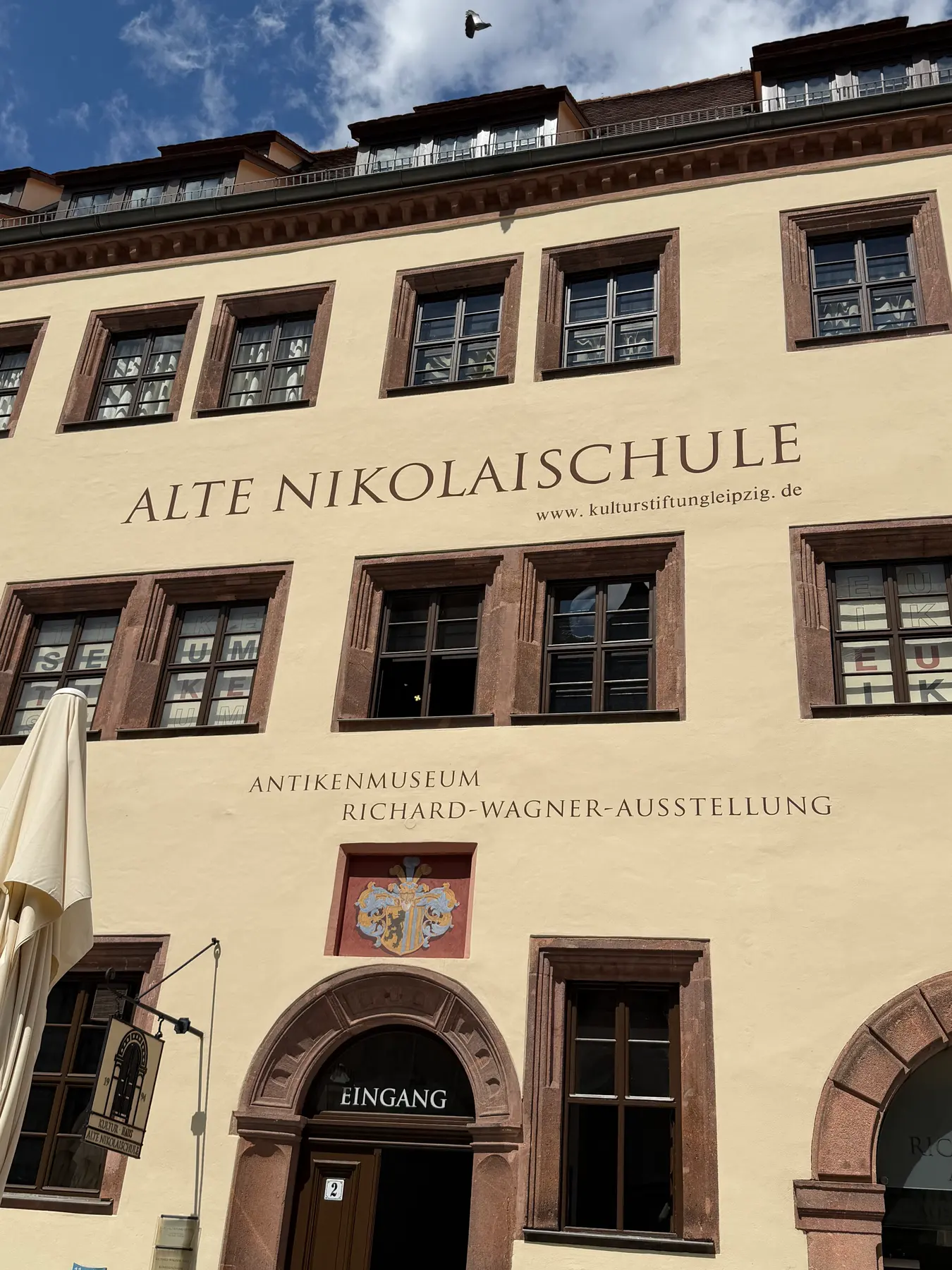
Leipzig / DE
Wagner's former school houses the permanent exhibition The Young Richard Wagner, 1813 to 1834.

Leipzig / DE
Wagner attended St Thomas School during the final phase of his Leipzig education.
.JPG?width=720)
Leipzig / DE
Wagner enrolled at Leipzig University in 1831 while studying composition with Theodor Weinlig.

Leipzig / DE
Leipzig concert life presented Wagner’s early orchestral works, including his Symphony in C major.

Prague / CZ
Wagner met the Pachta family in 1832 and showed his own family their Prague palace when he returned in 1875.

Pravonín / CZ
Wagner visited the castle during an early journey through Bohemia and Prague.
Würzburg / DE
Wagner lived in the former Lochgasse while working as chorus master at the Würzburg theatre.

Würzburg / DE
Wagner’s first regular theatre appointment brought him to Würzburg as chorus master.

Bad Lauchstädt / DE
Here the 21-year-old Wagner conducted Mozart's Don Giovanni in 1834 and began his practical career as an opera conductor.

Magdeburg / DE
Wagner worked as music director of the Magdeburg theatre company. Das Liebesverbot premiered in the former municipal theatre in 1836.

Teplice / CZ
Wagner stayed here with Theodor Apel in 1834 and returned to the same hotel with Cosima and his family in 1875.

Teplice / CZ
At the Schlackenburg Wagner drafted the libretto of Das Liebesverbot in 1834; he revisited the site in 1875.

Kaliningrad / RU
Wagner worked as music director at the Königsberg theatre before moving to Riga.

Kaliningrad / RU
Richard Wagner and Minna Planer married in Königsberg’s Tragheim Church.

Riga / LV
One of Wagner’s documented Riga addresses during his city-theatre years.
Jelgava / LV
Mitau formed part of the theatre network in which Wagner and Minna worked between Königsberg and Riga.

Riga / LV
Wagner’s later Riga residence belongs to the period in which Rienzi was taking shape.

Riga / LV
Wagner and Minna secretly left the Russian Empire through the coast near Dünamünde on their way to the ship Thetis.

Baltiysk / RU
At Pillau, Wagner and Minna boarded the Thetis without valid papers, beginning the voyage that helped shape The Flying Dutchman.

Paris / FR
One of Wagner’s first modest Paris addresses during his financially difficult years.

Boulogne-sur-Mer / FR
After the stormy sea voyage and England, Wagner reached the continent on his way to Paris.

Tvedestrand / NO
The Thetis sought shelter here from the storm; Wagner later connected the fjord echoes with The Flying Dutchman.
%20-%202021-06-28%20-%201.jpg?width=720)
Paris / FR
Wagner and Minna rented their own flat here before moving temporarily to Meudon.

Meudon / FR
In this house outside Paris, Wagner worked on The Flying Dutchman amid severe financial hardship.
Meudon / FR
The plaque outside the house records the precarious creation history of The Flying Dutchman.

Dresden / DE
Dresden became the site of Wagner's public breakthrough with the premieres of Rienzi, Der fliegende Holländer and Tannhäuser.
%20Die%20Wartburg%20von%20Norden.jpg?width=720)
Eisenach / DE
The Wartburg and the legend of the singing contest became the real and mythical space of Tannhäuser.

Dresden / DE
After returning from Paris, Wagner lived near the Dresden court theatre in the former Töpferstrasse.

Eisenach / DE
The legendary landscape near the Wartburg forms part of the mythic geography from which Wagner shaped Tannhäuser.

Dresden / DE
This address belongs to Wagner’s years as Dresden court conductor and the premieres of Dutchman and Tannhäuser.
%2002.jpg?width=720)
Mariánské Lázně / CZ
In Marienbad, Wagner sketched Lohengrin and the basic idea of Die Meistersinger.

Mariánské Lázně / CZ
The surviving spa house is explicitly associated with Wagner’s 1845 stay in the World Heritage inventory.

Graupa / DE
Wagner spent eleven weeks here in the summer of 1846 and worked on the musical conception of Lohengrin.

Graupa / DE
The permanent exhibition in the hunting lodge presents Wagner in Saxony, his working methods, sources, orchestral ideas and theatre concepts.

Pirna / DE
A monumental Wagner as a Grail knight stands within a dramatic rock landscape on a route Wagner may have walked in similar form.

Dresden / DE
Wagner occupied rooms around the Palais Marcolini until his flight after the Dresden May uprising.

Zurich / CH
Wagner’s first Zurich lodging after fleeing Dresden stood at Weinplatz.

Zurich / CH
Wagner stayed with Alexander Müller first in late May and again from July to September 1849; here he wrote Art and Revolution.

Zurich / CH
Wagner, Minna and Natalie lived at Haus Akazia for only about a week from 7 September 1849; Wagner worked there on his Wibelungen essay.

Zurich / CH
In the rear Escher houses Wagner wrote central theoretical works and the draft for Wieland the Smith.

Zurich / CH
Wagner conducted and worked within the musical life of Zurich’s Aktientheater, predecessor of today’s opera house.
.jpg?width=720)
Weimar / DE
Franz Liszt conducted the premiere of Lohengrin in Weimar while Wagner was living in Swiss exile.

Zurich / CH
In the apartment at Zeltweg 11 Wagner worked on the texts of the Ring des Nibelungen.

La Spezia / IT
Wagner later connected a half-waking state at the Gulf of La Spezia with the sonic vision of the E-flat opening of Das Rheingold.
Zurich / CH
Here Wagner composed Das Rheingold and Die Walküre as well as the beginning of Siegfried.

London / GB
Wagner conducted eight Philharmonic Society concerts here.

Zurich / CH
Within the Wesendonck circle, central parts of Tristan und Isolde and the Wesendonck Lieder emerged. The villa is now part of Museum Rietberg.

Zurich / CH
The small house on the Wesendonck estate was a decisive workplace for Tristan, Siegfried and the Wesendonck Lieder.

Venice / IT
Wagner moved to Venice to continue Tristan und Isolde in the greatest possible seclusion.

Lucerne / CH
At the Schweizerhof, Wagner completed the score of Tristan und Isolde.

Mainz / DE
The Mainz publisher Schott became a central partner in publishing several of Wagner’s works.

Paris / FR
A plaque recalls Wagner’s Paris stay around the Tannhäuser production.

Paris / FR
Wagner conducted three concerts of excerpts from his works here immediately before the Paris Tannhäuser project.

Brussels / BE
Wagner gave two successful Brussels concerts following his Paris concert series.

Paris / FR
This was the site of the notorious Paris premiere of Tannhäuser, withdrawn after three performances.

Bad Reichenhall / DE
A short documented spa-town stay adds one of the often overlooked travel stations between major work locations.

Wiesbaden-Biebrich / DE
Wagner lived in Biebrich for several months in 1862 and worked intensively on Die Meistersinger von Nürnberg.
%202015-09.jpg?width=720)
Wiesbaden / DE
Wiesbaden formed part of Wagner’s concert and travel years between Biebrich, Paris, Vienna and Russia.

Vienna / AT
The hotel preserves a piano associated with Wagner’s Vienna work on Die Meistersinger.

Vienna / AT
Wagner lived here during intensive work on Die Meistersinger and his Vienna theatre plans.

Vienna / AT
Wagner conducted a concert in the Redoute Hall during his European concert years.

Budapest / HU
Wagner conducted two enthusiastically received concerts at the National Theatre.

Prague / CZ
Wagner rehearsed and conducted concerts of his own music on Žofín Island.

Prague / CZ
During Wagner’s Prague concert visit, The Flying Dutchman was performed in his honour.
%20-%204.JPG?width=720)
Saint Petersburg / RU
Wagner conducted several concerts in this large hall with players from the imperial orchestras.

Moscow / RU
Moscow was the second major station of Wagner’s Russian concert tour.
.jpg?width=720)
Prague / CZ
The two concerts led by Wagner made Prague a notable station in his international conducting years.

Stuttgart / DE
Wagner stayed here shortly before the decisive intervention of King Ludwig II; a plaque marks the visit.

Munich / DE
Wagner lived at the former Briennerstrasse 21 during the early period of Ludwig II’s patronage.

Kempfenhausen / DE
Ludwig II housed Wagner beside Lake Starnberg, where he worked near the royal court.
.jpg?width=720)
Stuttgart / DE
The plaque marks the stay immediately preceding Wagner’s rescue by Ludwig II.

Munich / DE
Tristan und Isolde, Die Meistersinger, Das Rheingold and Die Walküre received their premieres here.

Munich / DE
The hotel served as a meeting place around the Tristan premiere and later as a stop for the Wagner family.

Lucerne / CH
Wagner lived for six years in the Tribschen country house beside Lake Lucerne. It is now a museum with original objects and his Erard piano.

Augsburg / DE
Wagner stayed several times at Augsburg’s historic hotel.

Hohenschwangau / DE
Ludwig II created rooms and image cycles deeply shaped by Wagner, Lohengrin, Tannhäuser and medieval legend.

Bayreuth / DE
The reputation of the great Baroque opera house drew Wagner's attention to Bayreuth, but its stage proved unsuitable for his plans.
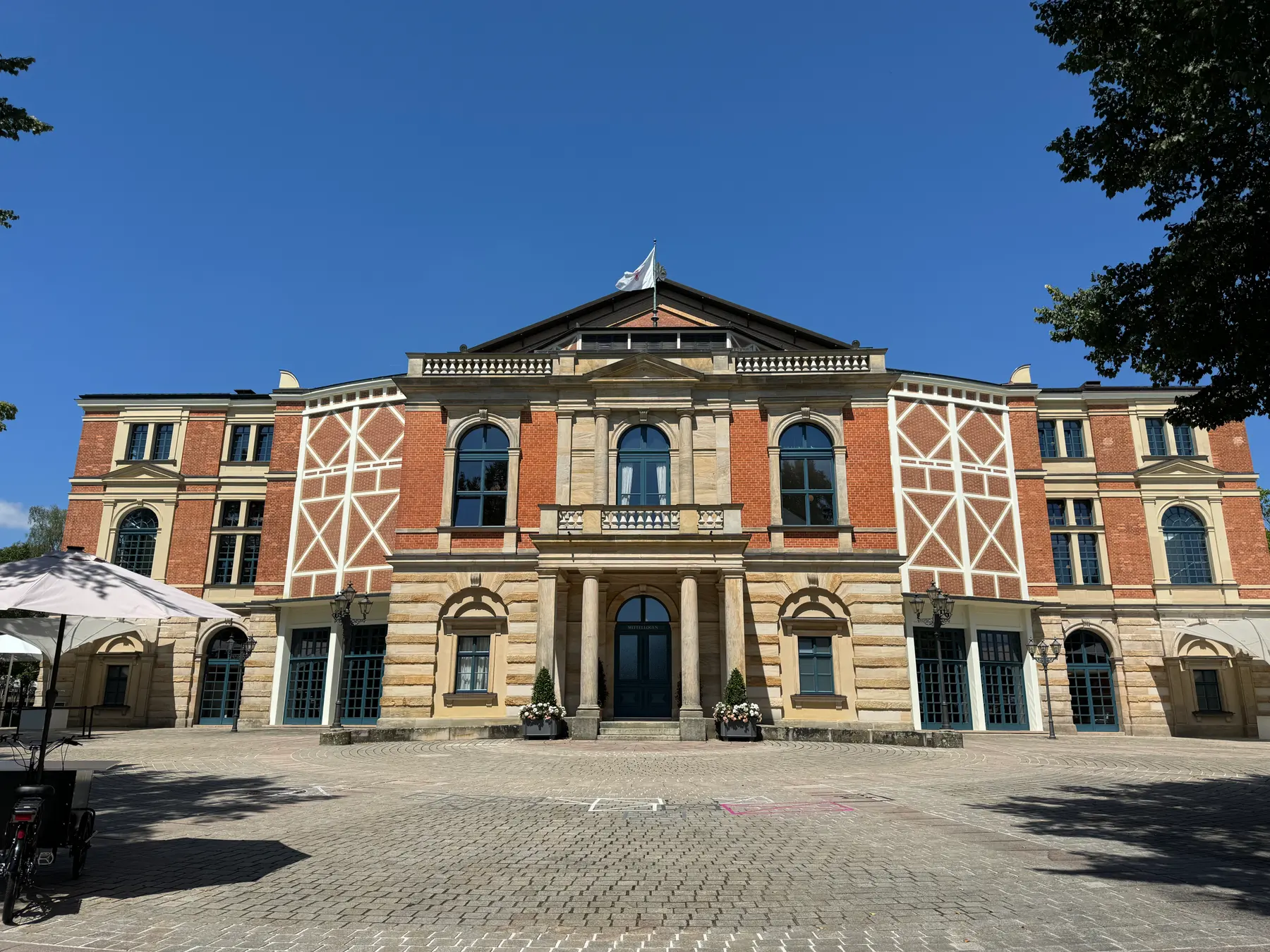
Bayreuth / DE
The theatre built specifically for Wagner's works, with its concealed orchestra pit, opened in 1876 with the first complete Ring cycle.
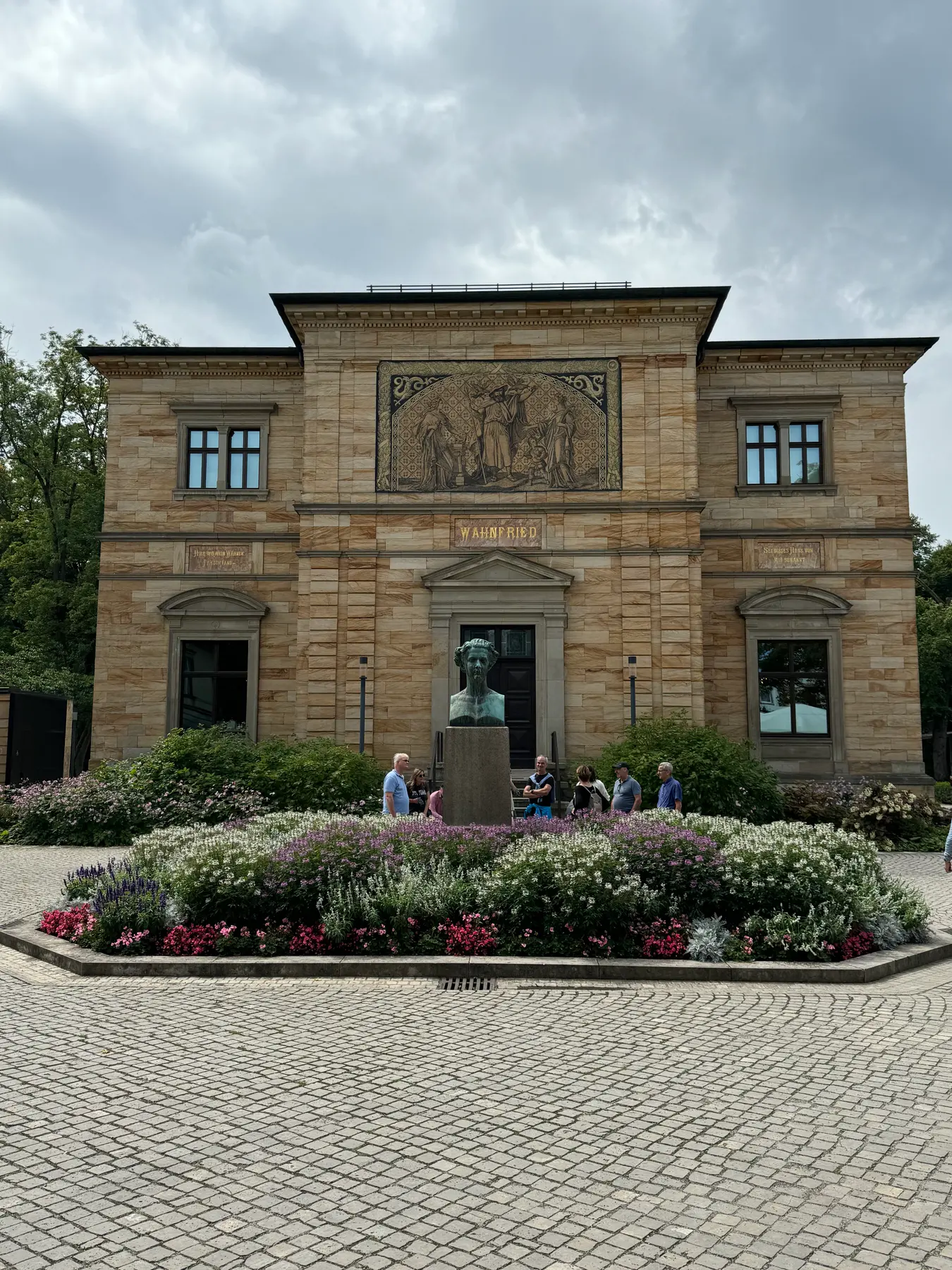
Bayreuth / DE
Wagner's Bayreuth home is now the centre of the Richard Wagner Museum and a major place for his life, work and festival history.

Bayreuth / DE
Wagner’s first residence in Bayreuth stood here while Wahnfried was under construction.

Eckersdorf / DE
Before moving into the town, the family stayed at Hotel Fantaisie; a Wagner room recalls the visit.
.jpg?width=720)
Schwerin / DE
Wagner and Cosima stayed here while travelling to audition singers for Bayreuth.
Schwerin / DE
The plaque recalls Wagner’s stay at the former Hotel Stern and his search for Bayreuth singers.

Ettal / DE
Ludwig II had an artificial grotto built that materialised the Venusberg from Tannhäuser as a private theatrical illusion.
%202012.jpg?width=720)
Brunswick / DE
Wagner auditioned a singer for Siegfried in Brunswick; a plaque recalls his nights at the hotel.

Vienna / AT
Wagner stayed at the Imperial for two months while Lohengrin was being prepared at the Court Opera.
.JPG?width=720)
Vienna / AT
In Vienna, Wagner supervised rehearsals and staging questions for his works, especially Lohengrin.

Budapest / HU
Wagner and Liszt conducted a concert here together.
%20-%202a.jpg?width=720)
Teplice / CZ
On his final Teplitz visit Wagner bathed at the Imperial Spa, built in 1872, and breakfasted there with Cosima.

Vienna / AT
The marble plaque on the facade makes Wagner’s extended hotel stay visible in the city.
Brunswick / DE
The plaque at the site of Schraders Hotel recalls Wagner’s casting journey for the first Bayreuth Ring.

Sorrento / IT
Wagner stayed here with Cosima and the family; the visit belongs to the early work on Parsifal.

London / GB
A plaque records that Edward Dannreuther hosted Wagner in 1877 during the London concerts.

London / GB
Wagner conducted a series of large concerts at the Royal Albert Hall in 1877 to raise funds for Bayreuth.

Ravello / IT
The gardens of Villa Rufolo are associated with Wagner's conception of Klingsor's magic garden in Parsifal.

Siena / IT
The spatial impression of Siena Cathedral is associated with Wagner's vision of the Grail temple in Parsifal.
.jpg?width=720)
Naples / IT
Wagner lived for several months in the villa above the Bay of Naples and continued work on Parsifal.
%20-%20Fa%C3%A7ade%203.jpg?width=720)
Palermo / IT
Wagner spent several months in Palermo with his family and completed the score of Parsifal there.

Venice / IT
Wagner's final residence was in this palace on the Grand Canal. A museum there now recalls his final months.
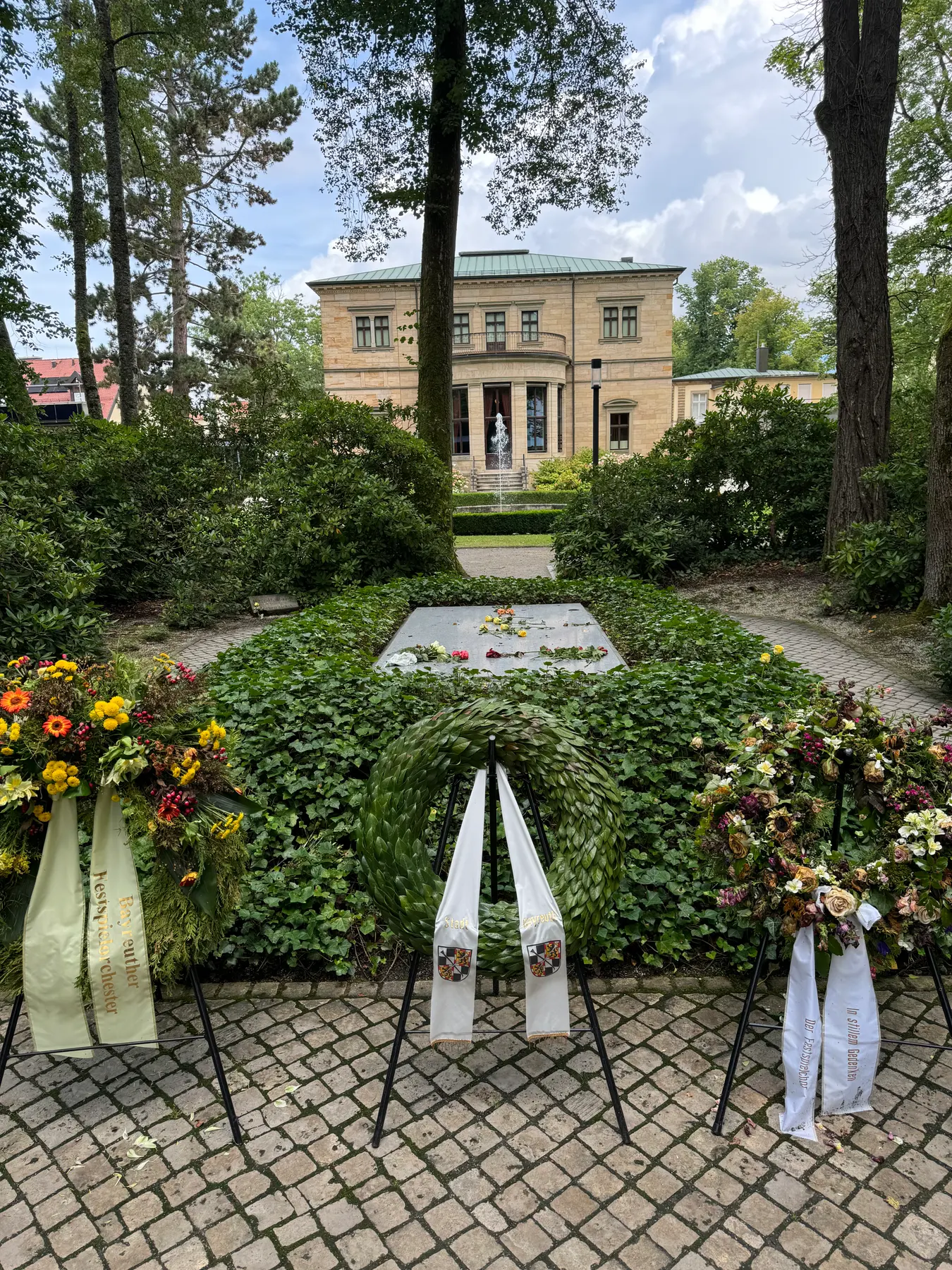
Bayreuth / DE
Richard Wagner was buried in the garden of Wahnfried House, later joined by Cosima Wagner.

Venice / IT
The plaque on the house where he died marks Wagner’s final biographical location in Venice.
.jpg?width=720)
Eisenach / DE
The villa houses one of the most important Wagner collections outside Bayreuth.

Munich / DE
The theatre was built in the Bayreuth tradition and became a major Munich site of Wagner reception.
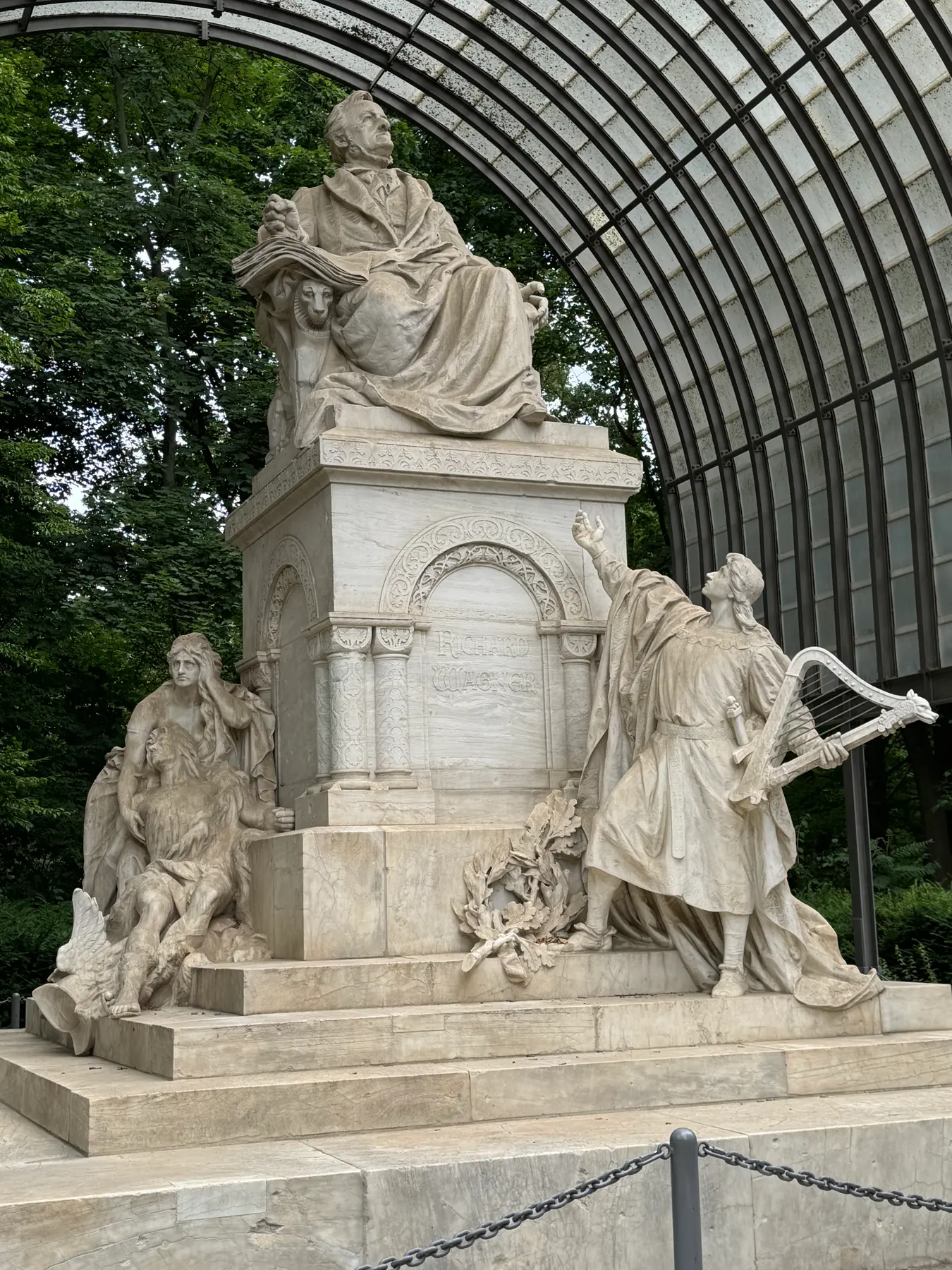
Berlin / DE
Gustav Eberlein’s large monument presents Wagner amid figures and motifs from his stage works.
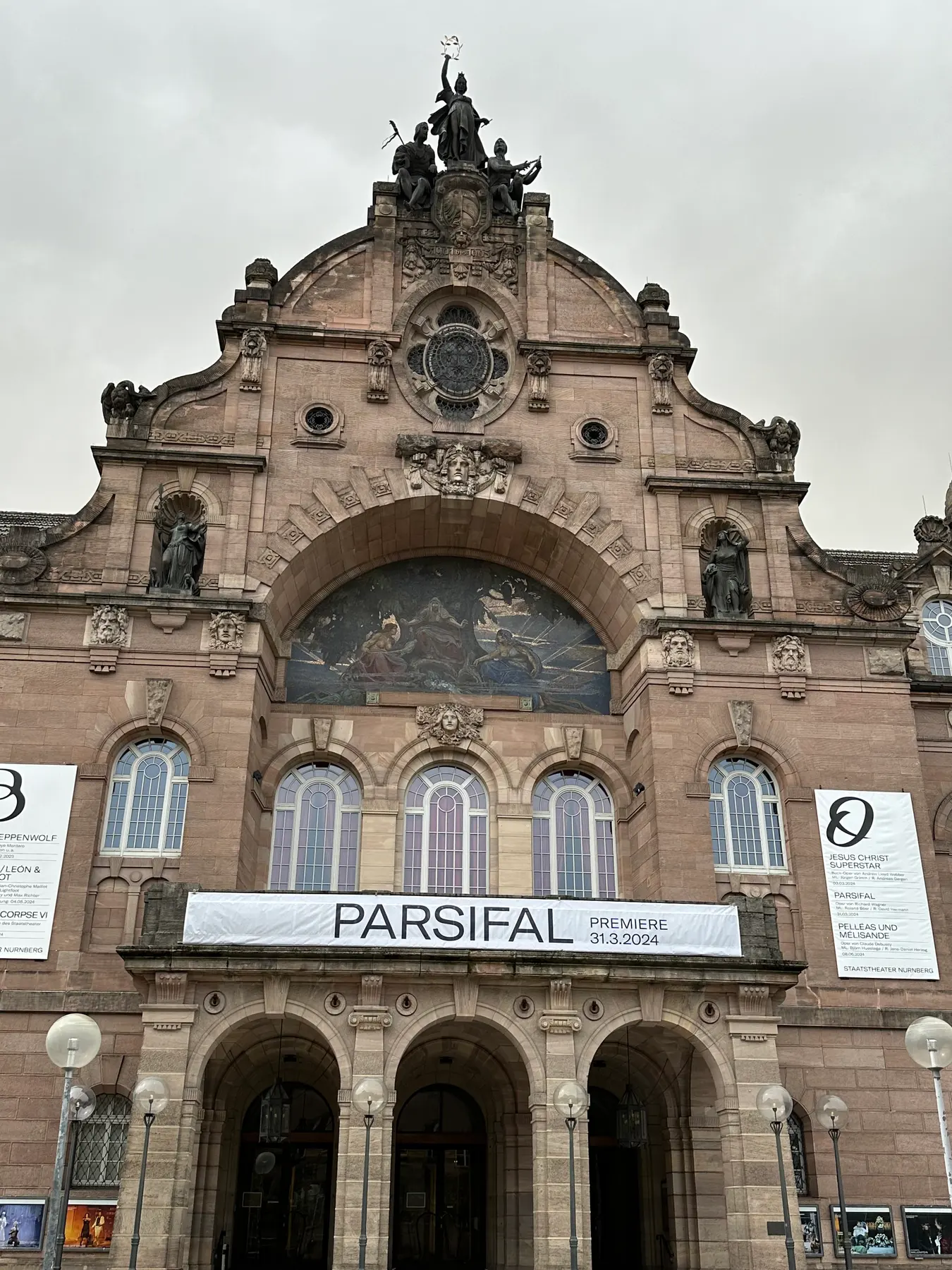
Nuremberg / DE
Nuremberg's opera house opened in 1905 with Die Meistersinger von Nürnberg.
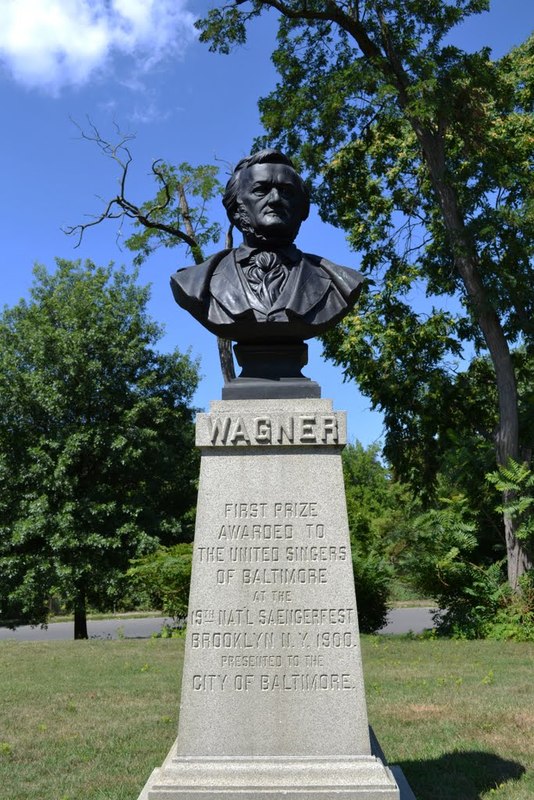
Baltimore / US
The bust documents Baltimore’s strong organised Wagner enthusiasm around 1900.
.jpg?width=720)
Venice / IT
Fritz Schaper’s monument in the Biennale Gardens recalls Wagner’s close relationship with Venice and his death in the city.

Cleveland / US
The statue is among the most prominent Wagner monuments outside Europe.

Zurich / CH
The bust in Rieterpark recalls Wagner’s Zurich work years beside the former Wesendonck estate.
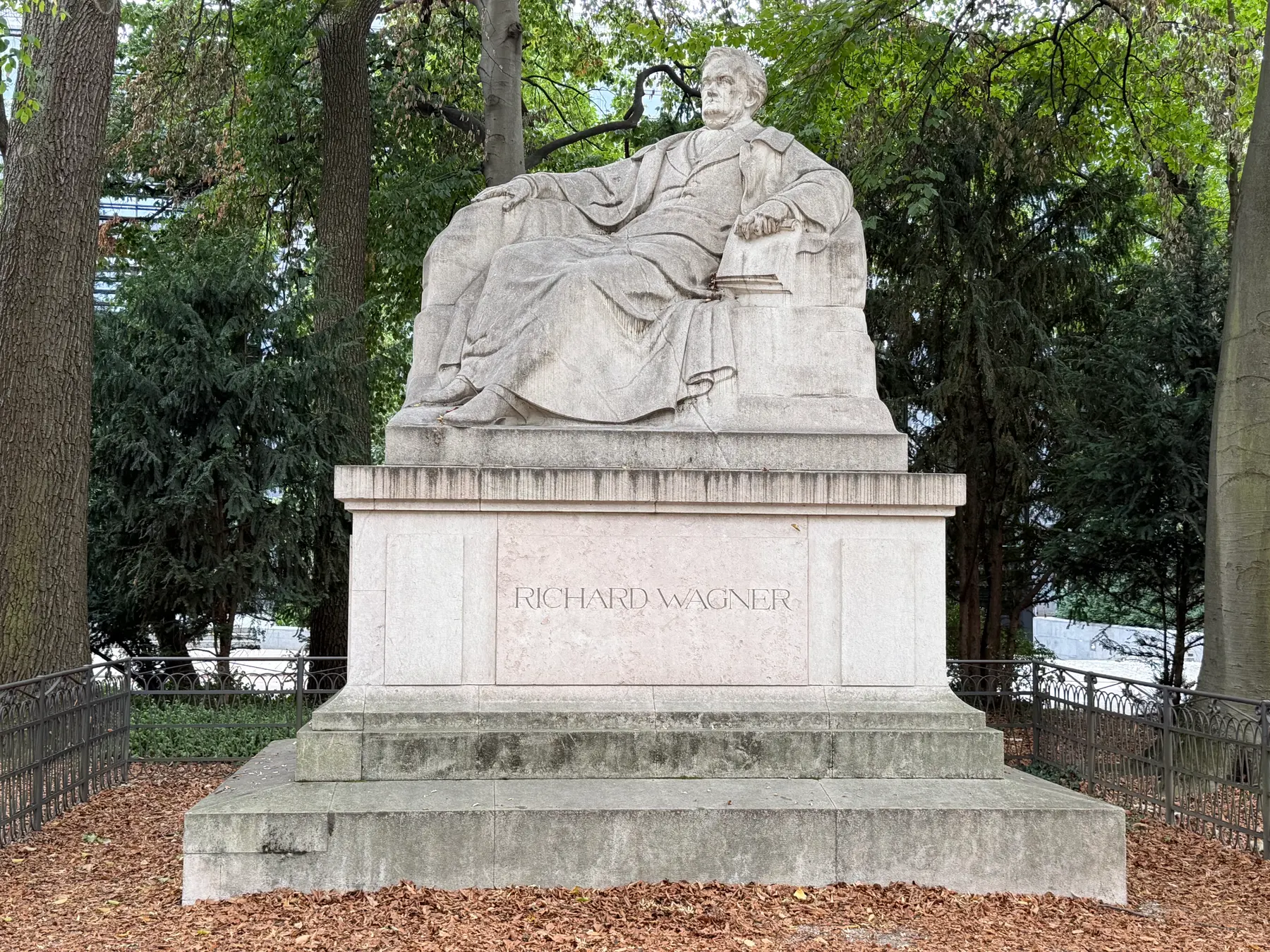
Munich / DE
Heinrich Waderé’s monumental figure of Wagner stands near the Prinzregententheater.

Königswinter / DE
The hall on the Drachenfels opened for Wagner’s centenary and combines Ring imagery, architecture and dragon myth.
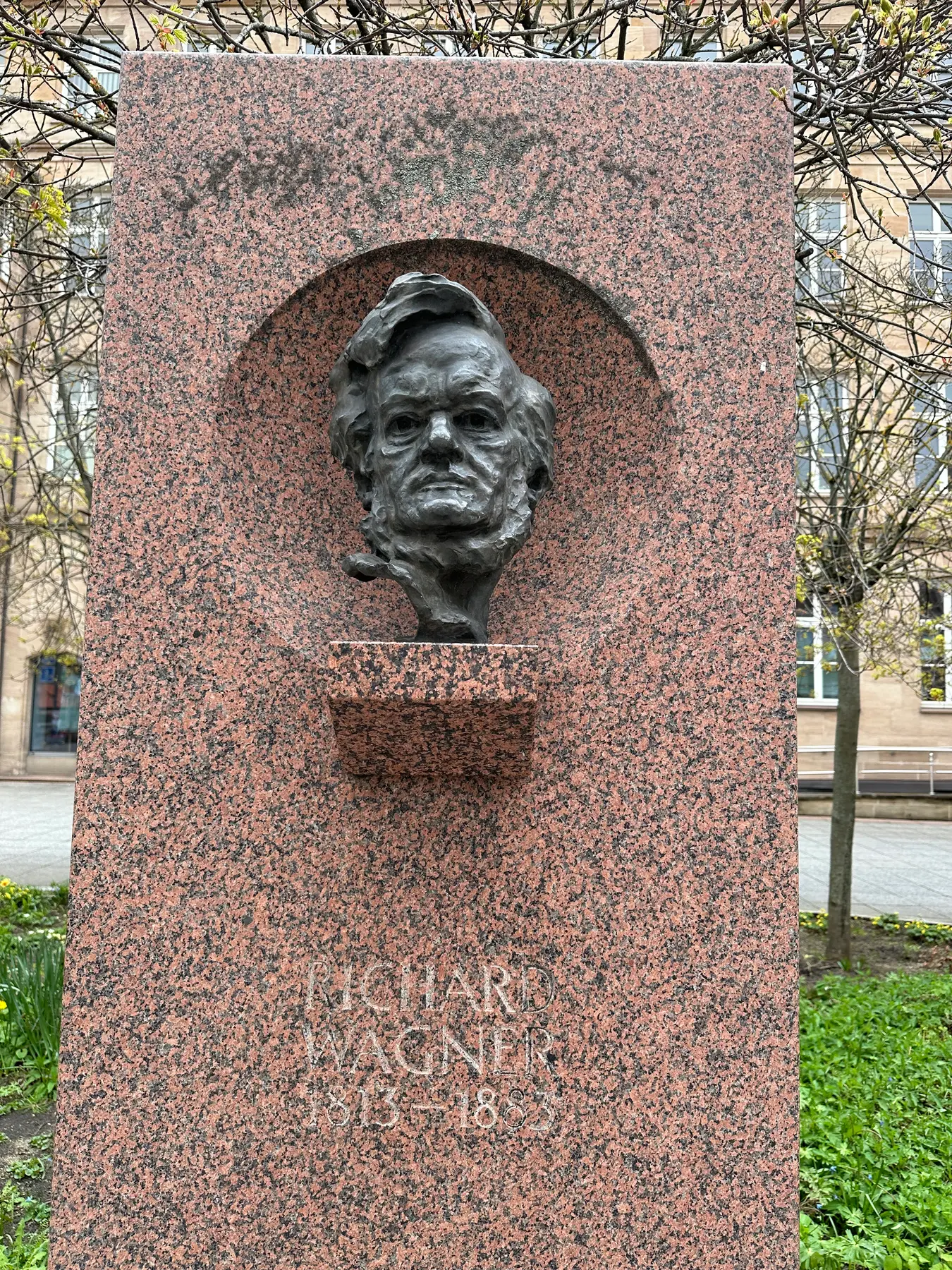
Nuremberg / DE
The monument outside the opera house connects the city directly with its most famous Wagner title.
Leipzig / DE
The grove beside the Elster floodplain preserves the spatial trace of an unrealised monumental Wagner project.

Bayreuth / DE
The National Archives preserves the world's largest and most important Wagner collection, including manuscripts, letters, scores, images and libraries.
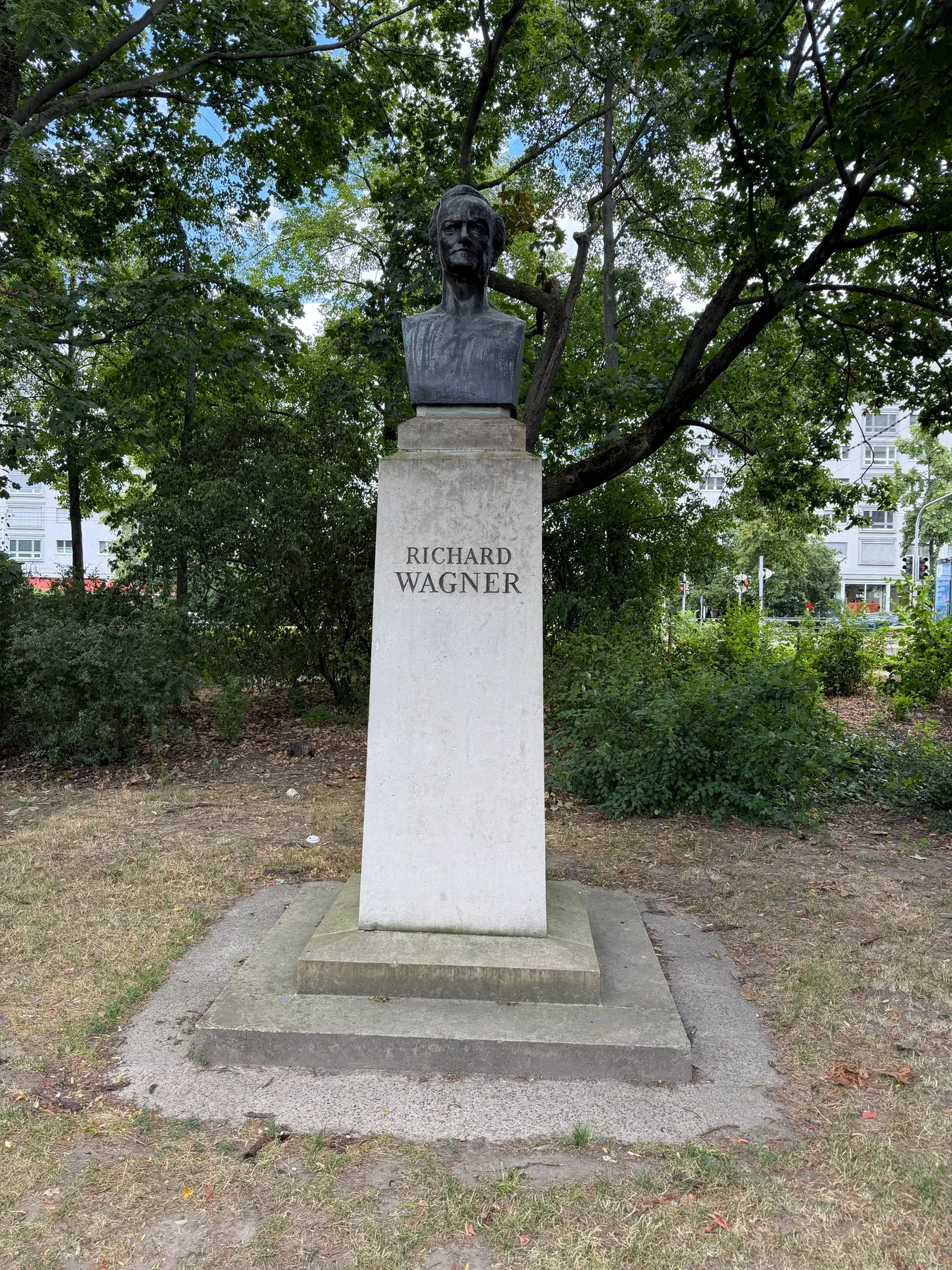
Leipzig / DE
The bust beside the Schwanenteich is a distinct Leipzig memorial apart from the larger monument on the promenade ring.
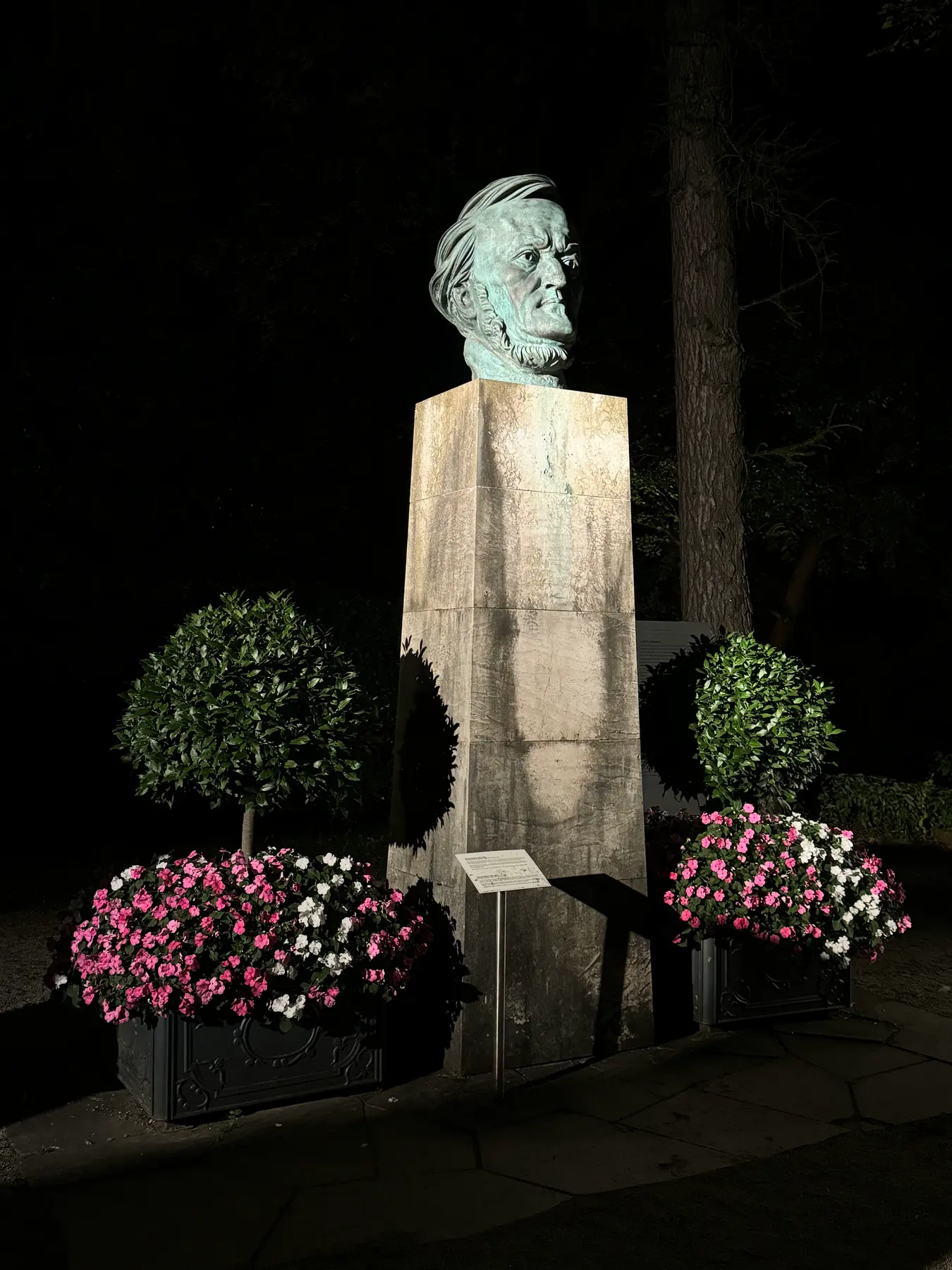
Bayreuth / DE
The statue in the Festival park forms part of the layered memorial landscape around the Festspielhaus.
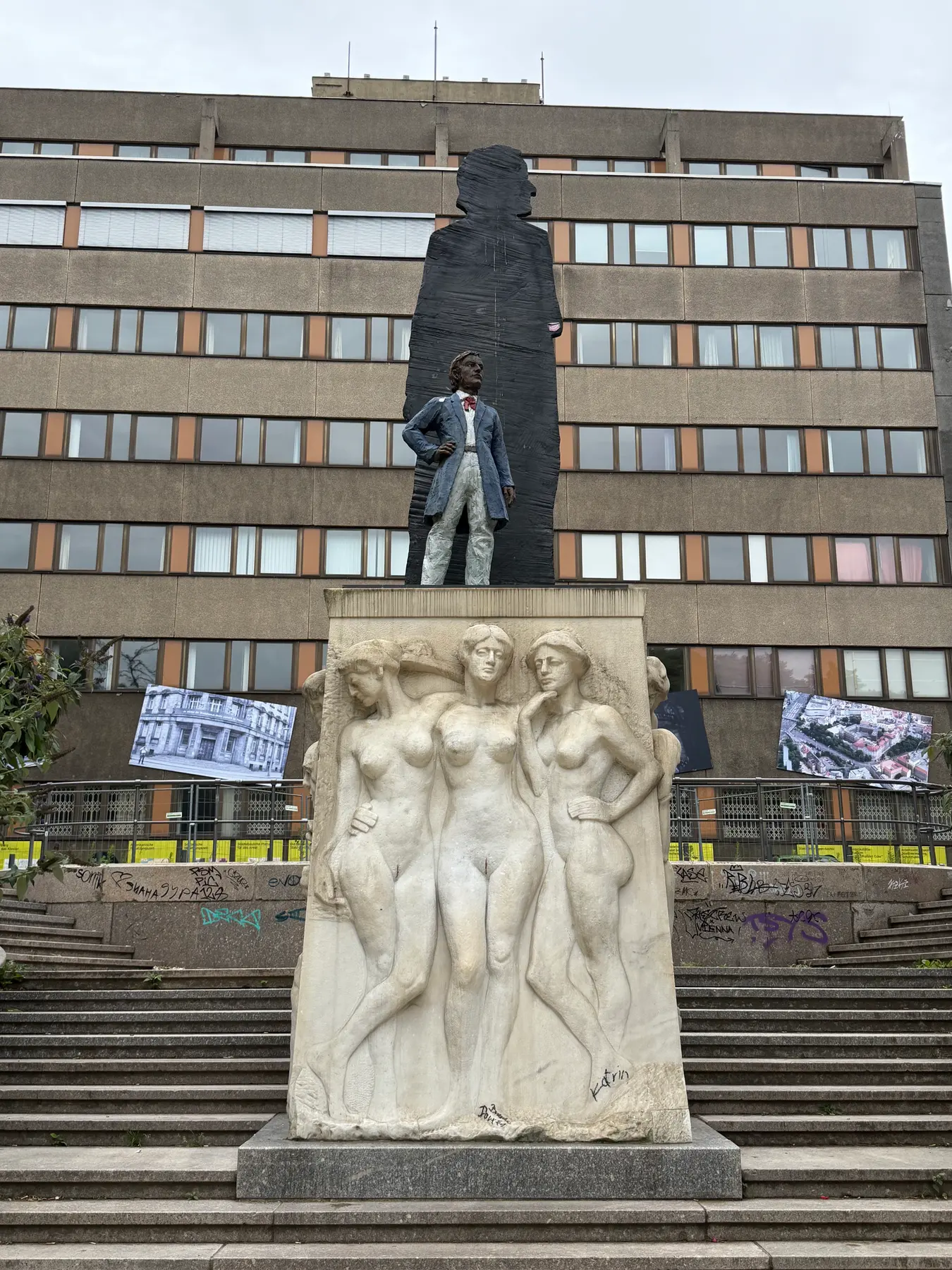
Leipzig / DE
Stephan Balkenhol's monument joins Max Klinger's historic plinth with a deliberately contemporary Wagner figure.

Barcelona / ES
The memorial in Turó Park honours Richard Wagner and the Catalan musician Joan Llongueras.
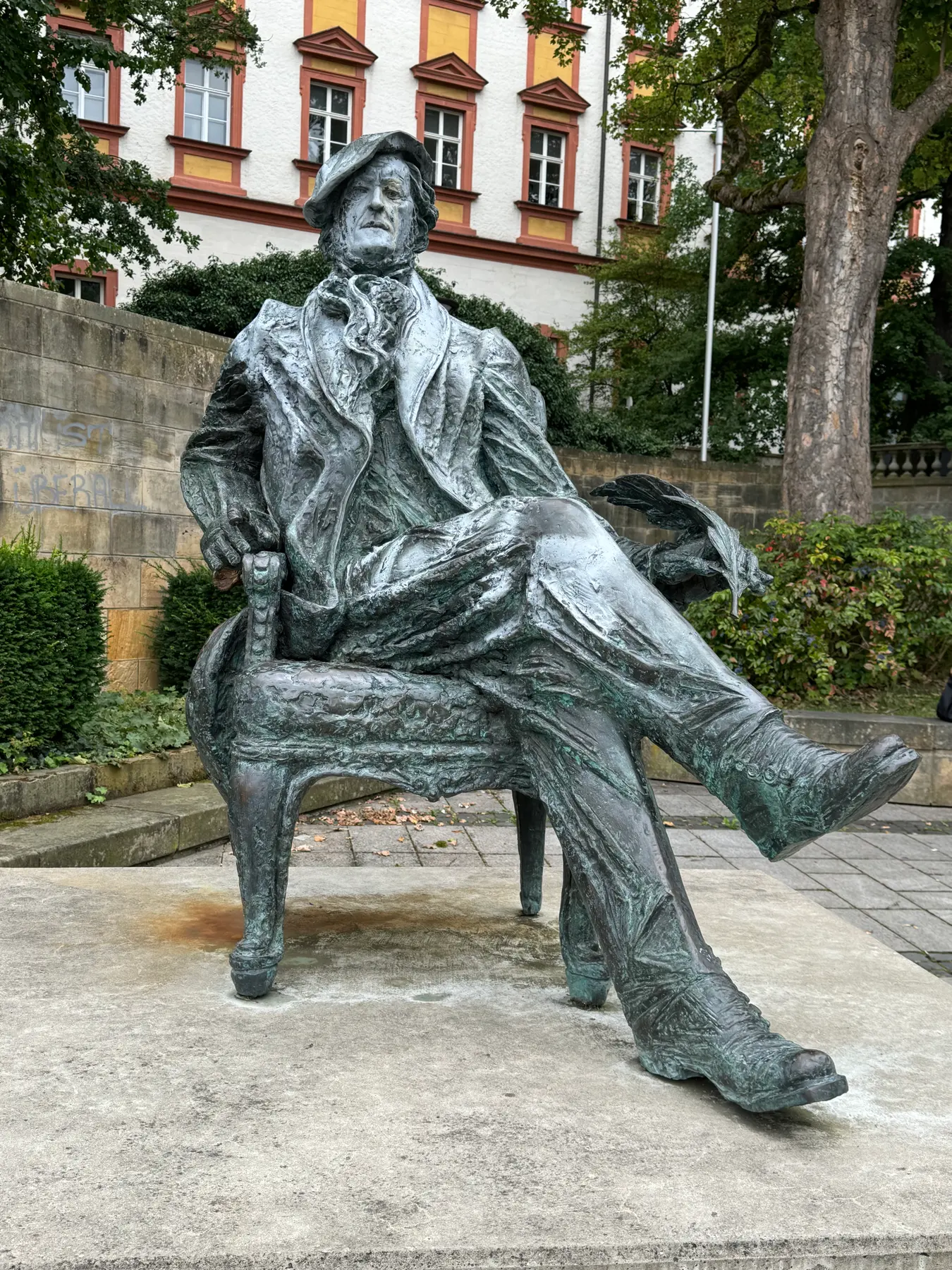
Bayreuth / DE
The life-size bronze by the artist Aidyn Zeinalov – a gift from the twin city of La Spezia for the 20th anniversary of the partnership – shows Richard Wagner seated and recalls his 1853 stay in La Spezia, where the E-flat major motif of the ‘Rheingold’ prelude came to him in a half-dream.